


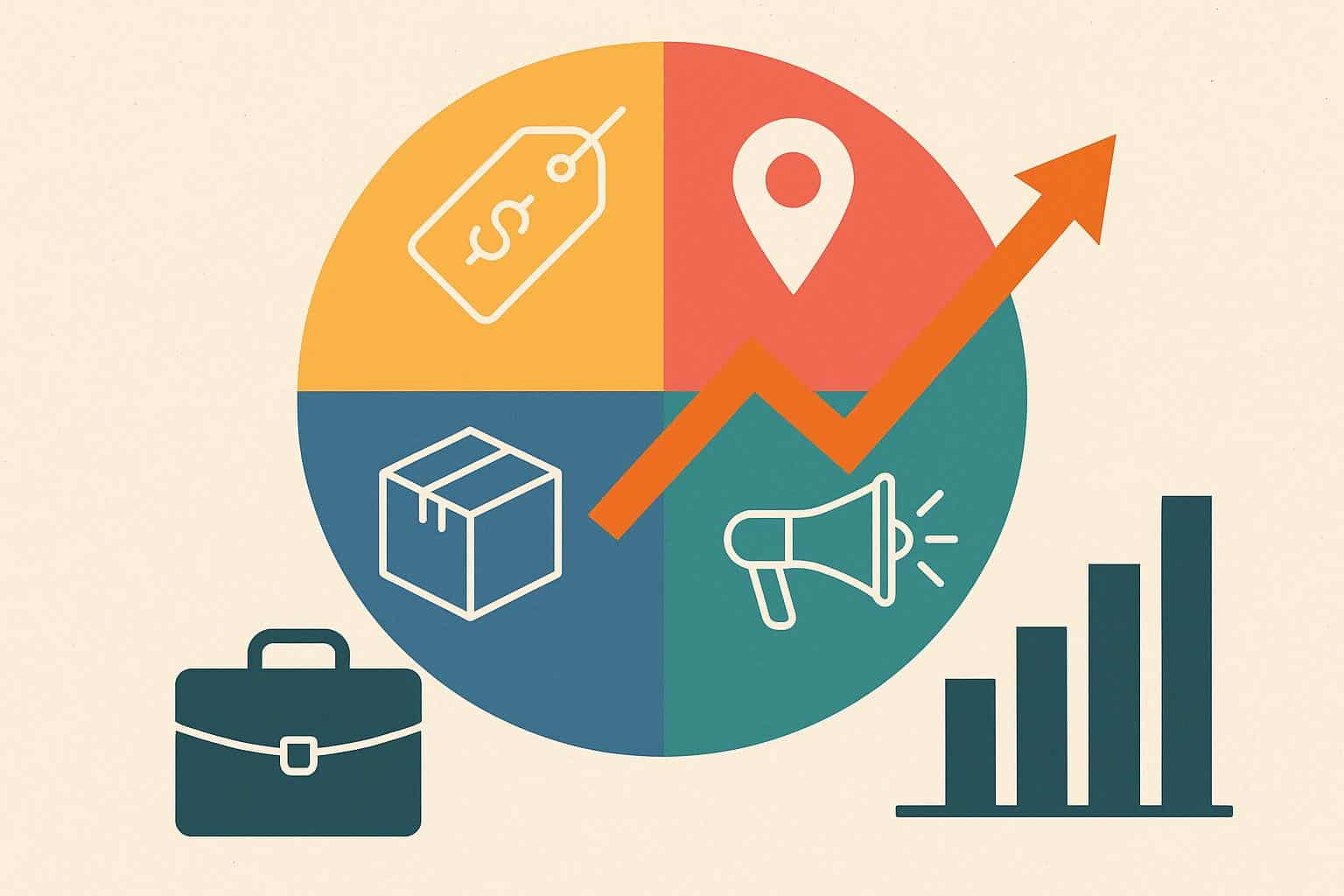
Originally introduced in his book Basic Marketing: A Managerial Approach (1960), E. Jerome McCarthy developed the “4 Ps of Marketing,” a concept that has remained integral to crafting impactful marketing strategies that consistently increase revenue for over 60 years.
The 4 Ps are product, placement, pricing, and promotion. While many businesses think of marketing only as promotion, the product, placement, and pricing “Ps” are frequently overlooked or managed in other parts of the organization rather than integrated into a comprehensive, holistic marketing approach. Those who prioritize all 4 Ps of Marketing are better positioned to achieve their revenue and growth objectives more cost-effectively.
Marketing P #1: Product
In business, the term “product” encompasses a wide range of offerings, including physical goods, software, and services.
The most valuable products are those that effectively overcome challenges and open up new possibilities. Identifying the ideal target market, often referred to as the ideal client/customer profile (ICP), is crucial as it comprises individuals or entities most likely to recognize the value of a product and are willing to invest in it to ensure profitability.
It’s important to note the distinction between clients and customers, as even seasoned professionals conflate these terms: professional relationships are developed with clients, and transactions are conducted with customers.
Product roadmaps play a crucial role in outlining future iterations of a product, aimed at resolving additional challenges and delivering greater value to existing or potential target markets. Product managers bear the responsibility of comprehensively understanding the “voice of the customer,” encompassing both end-user and channel partner needs. They collaborate with engineers and developers to fulfill as many of these requirements as possible within the constraints of time and budget. Any unmet needs in the current version of a product may be addressed in subsequent iterations, thereby shaping the product roadmap.
Marketing P #2: Placement
The most often overlooked 4P is the “placement” of products with customers. This is also known as your go-to-market strategy, which identifies whether a product is sold directly to customers and/or through channel partners. Even within the same organizations, different products may be sold through different types of channel partners, especially in other countries.
Many organizations opt to sell through channel partners who already have established relationships within a target market. This allows access to markets through channel partners who purchase the product at a discount, enabling them to mark it up and make a profit. For new technology solutions (software and hardware), channel partners typically seek up to a 40% margin, while they may expect up to a 20% margin for older, commodity products.
Service providers usually sell to customers directly, as services do not require stocking or installation like physical products and software. However, there are exceptions, such as general contractors who use subcontractors on construction projects – the subcontractors essentially sell their services to a developer or owner through the GC.
Marketing P #3: Pricing
Determining the optimal price for a product and establishing pricing for direct sales versus channel sales is essential to any pricing strategy that maximizes profitability.
Understanding customer perspectives of value is critically important and can be achieved with market research. This information helps in determining the price point at which most ideal prospects are willing to make a purchase. Understanding the cost of goods sold (COGS) is also imperative to ensure products are priced adequately to yield a profit on each sale.
Furthermore, it is essential to align the pricing strategy with the profitability objectives set by ownership and the executive team. This involves setting clear profitability targets for each product. If the market’s willingness to pay does not meet profitability targets, alternative strategies to enhance the product’s value need to be explored, or the pricing strategy may need to be re-evaluated.
Marketing P #4: Promotion
Often referred to as the fourth “P” of marketing, promotion focuses on communicating the value of products to potential customers and channel partners.
Promotional marketing consists of two primary types: inbound and outbound. Inbound marketing targets prospects that are actively seeking a specific product. This involves leveraging website content with search engine optimization (SEO) to capture that demand.
The second type is outbound marketing, which aims to generate demand by delivering marketing messages to people who are not actively searching for a product. This can be achieved through various campaigns such as email, ads, public relations, guest appearances on shows, and both in-person and virtual events.
Promotional marketing is conducted through both print to digital. Now considered more traditional, yet still relevant, print media include advertising, direct mail, catalogs, and promotional merchandise distributed at events.
On the other hand, digital marketing involves promotions that exist solely on digital platforms, such as websites, third-party websites, social media, email campaigns, and pay-per-click (PPC) ads on search engines.
Effective promotional marketing should yield a measurable return on investment (ROI), which requires a comprehensive understanding of the target market’s needs and values and effective communication that resonates.
Marketing P #5: Profit
When product, placement, pricing, and promotion are effectively incorporated into a marketing strategy, the most important “Fifth P” will be generated: profit.
While sales and revenue generation tend to be easier to measure and understand, profitability growth is what separates failure from success. It’s easy to get excited when revenues are growing, but this can be problematic if profits aren’t growing at the same rate
An effective marketing strategy that is aligned with prospect needs is essential for increasing B2B revenues and profitability – and is much easier when partnering with a B2B digital marketing agency that develops strategies every day and offers B2B digital, content marketing, and SEO services to implement them.
Whether you receive professional help or not, addressing all four Ps of marketing will help ensure accelerated revenue and profitability growth.
