


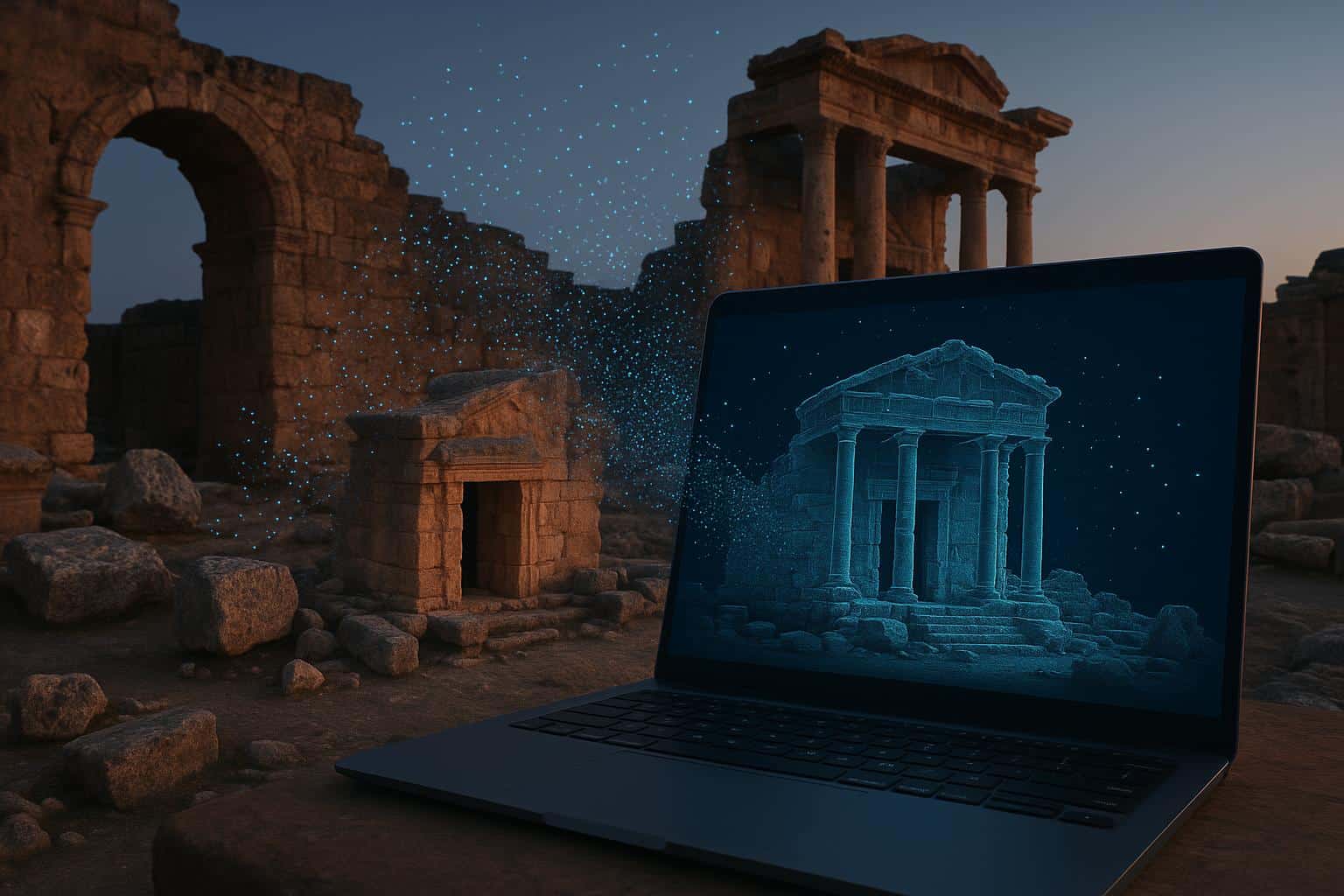
Old photographs, sketches, and written records can tell us a great deal about a historical site, but they rarely show every detail. Today, 3D digitization gives researchers another way to study damaged buildings and missing artifacts, using digital models to reconstruct features that may no longer exist.
With 3D rendering software and animation, archivists and digital artists can turn scan data, photographs, and historical records into detailed models of artifacts and buildings that have deteriorated or disappeared.
Bringing Ancient Ruins Back to Life
Preserving crumbling architecture requires immense precision. Photogrammetry and laser scanning help specialists record the condition of fragile ruins in considerable detail. The resulting point clouds can then be processed into 3D meshes that show the shape of walls, columns, and other architectural features. These models give conservation teams a digital record to study, especially when parts of a site are too unstable to access safely.
Once the geometry is secured, digital artists reconstruct landmarks as they appeared in their prime. Artists can also rebuild the surrounding landscape, add vegetation suited to the period, and adjust lighting to explore how a temple or public building might have looked. Historical records and archaeological evidence guide these decisions, although some details will inevitably remain open to interpretation.
An animated reconstruction can show visitors how a building may have looked before it deteriorated, then move through the changes that took place over time. This makes it easier to compare the surviving ruins with a proposed reconstruction of the original structure.
Advanced Material Mapping for Ancient Artifacts
Damage often leaves clues on an artifact’s surface. Fine cracks, faded pigments, mineral deposits, and changes in sheen can help researchers understand how an object has aged. Reproducing these details in a 3D model requires texture maps and material settings that reflect the condition of the original piece.
- Micro-Fissures & Structural Wear: Detailed displacement maps and high-frequency normal detail capture deep micro-cracks, eroded stone, flaking paint, and granular edge wear without distorting the underlying base geometry.
- Time-Worn & Layered Surfaces: Custom, multi-layered material shaders accurately mimic the natural aging process, reproducing weathered parchment, oxidized bronze patinas, yellowed varnish, and organic staining across varied surfaces.
- Micro-Surface Realism: Specular and roughness maps recreate the varied tactile qualities of age, balancing the matte absorption of dusty, pitted concrete with the polished luster of hand-worn wooden grain.
- Indestructible Archiving: Digitizing fragile relics and historic sites creates permanent, untouchable master assets, preserving their imperiled visual heritage indefinitely against ongoing physical decay and environmental degradation.
Careful material mapping helps a digital marble sculpture retain the subtle variations in its surface, while a bronze artifact can show the patina and discoloration caused by age. These details make digital records more useful for close study, even when the originals become too fragile to handle.
Creating Educational Content for Modern Museums
Museums can use digital reconstructions to help visitors explore objects and places that are difficult to experience in person. These displays work alongside traditional exhibits, offering a closer look at how a structure was built or how an artifact may have been used. High-resolution looping animations now project directly onto museum walls, letting visitors witness the construction and eventual decay of ancient wonders.
Exploded views bring complex historical mechanisms to life. Viewers can see every gear inside an ancient Greek astrolabe or examine hidden timber joinery within medieval architecture. Optimized 3D models can also be added to educational websites, digital museum collections, and classroom resources. Students can rotate an artifact, inspect features from different angles, and explore details that might be difficult to see in a photograph.
Technical Archiving Workflows for Future Generations
Saving a 3D reconstruction involves more than keeping a finished render. Institutions need to retain the source scans, model files, textures, and project documentation, preferably in formats that can be migrated as software changes. Maintaining those original files makes it easier to update a reconstruction without starting from scratch.
Structured metadata tagging links historical source documents, translation notes, and provenance data directly to specific components within a 3D model. This turns a visual model into an interactive database.
Clear documentation, reliable backups, and well-organized source files help museums and research institutions maintain their digital collections over time. Recording which details come from physical evidence and which have been reconstructed also allows future researchers to reassess the models as new historical information becomes available.
