


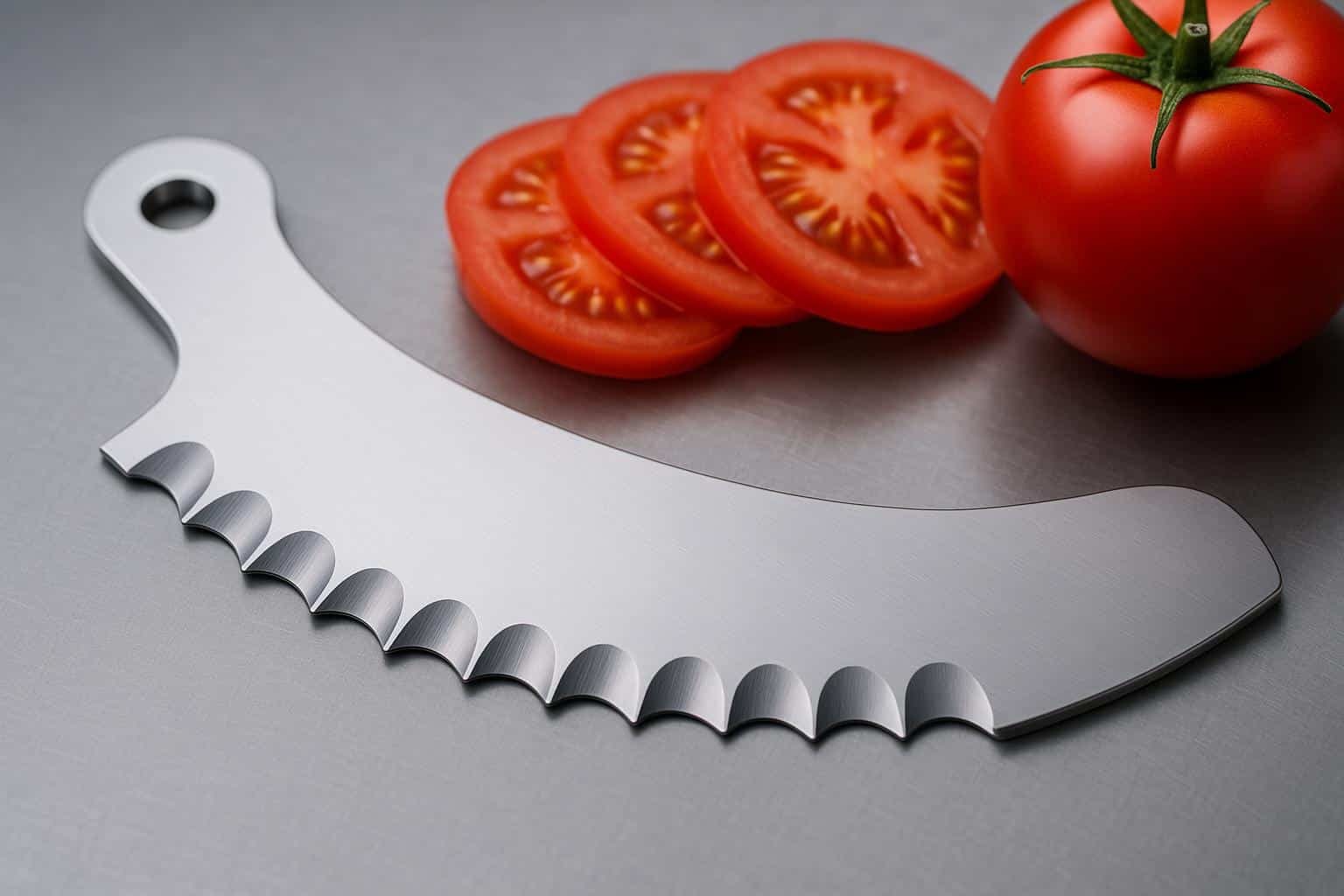
From constant exposure to salt, acids and near-continuous moisture to harsh cleaning products, industrial food processing blades must withstand a wide range of corrosive elements without compromising performance.
Maintaining a sharp, reliable edge under these conditions is critical not only for efficiency but also for consistency in food production elements.
Food processing blades, along with other equipment surfaces, are subject to strict quality and sanitation standards. The presence of foreign particles, debris or pathogens introduces health and quality risks, making surface integrity just as important as durability. Beyond safety and performance, food industry equipment is also held to a high aesthetic standard; a bright, polished appearance signals cleanliness, precision and trust.
For these reasons, manufacturers of food processing blades, which are typically made from 400-series heat-treated stainless steel, often turn to electropolishing, as this process enhances both the function and durability of the blades while also improving the metal’s appearance.
Electropolishing vs. Passivation for Improved Corrosion Resistance & Surface Integrity
Electropolishing produces a smooth metal surface free of defects often introduced during machining. Using an electrical current and a chemical bath, electropolishing removes a thin, precise layer of surface material, resulting in a clean, uniform finish with microfinish improvement of up to 50%.
It works by concentrating the electrical current across the microscopic surface peaks and leveling the high points.
During this process, blades are stripped of microcracks, pits, burrs and embedded contaminants that could otherwise compromise performance. Burrs, in particular, pose an unacceptable risk to food processing equipment. Often introduced during machining, burrs can interfere with cutting efficiency and pose a risk of breaking off during use, resulting in product contamination.
While passivation improves cleanliness and enhances corrosion resistance by removing free iron from the part’s surface, it does not remove any base material. By removing embedded contaminants and improving the surface finish, electropolishing enhances blade functionality and significantly improves corrosion resistance, making it the optimal choice for industrial food-processing blades.
Electropolished Surfaces Inhibit Pathogen Growth
Electropolished stainless steel has been shown to inhibit the growth of pathogens such as E. coli and salmonella by creating a surface that is inhospitable to their formation. This is a critical advantage as “biofilms” — complex microbial formations — are more resistant to standard cleaning and sanitization methods.
Research conducted by a division of the U.S. Department of Agriculture supports this advantage. In studies comparing 11 different finish types, electropolished stainless steel demonstrated the greatest resistance to biofilm formation. The findings were particularly important in the poultry industry, where rapid production cycles increase the risk of bacterial buildup and cross-contamination.
Aggressive Cleaning Processes Demand High Resistance to Corrosion
Industrial food processing blades must withstand frequent, aggressive cleaning to protect against bacteria and cross-contamination. The enhanced corrosion resistance imparted by electropolishing helps food-processing blades withstand such cleaning, improving durability and lifespan. Electropolishing provides stainless steel parts with up to 30x the corrosion resistance of passivation alone while leaving them in a passive state.
