


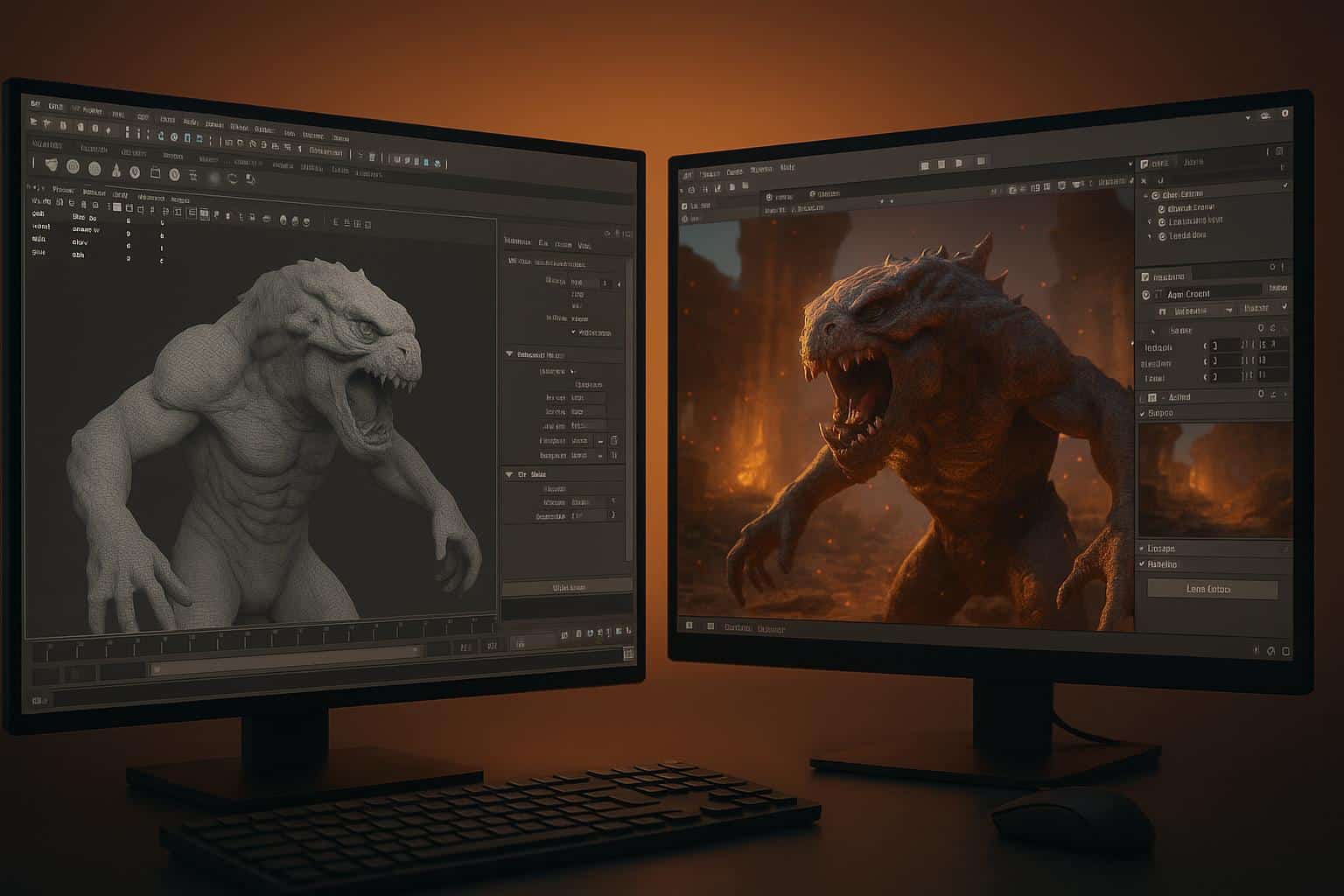
Game development is moving faster than perhaps any other visual effects space. Engines are iterating weekly, and player expectations are climbing with each new release cycle. In short, the better games get, the more players want them to get even better. Just ten years ago, studios could not have shipped the massive volume of visually complex titles you’re seeing today. The one sticking point for many developers is the offline workflow that slows teams down.
Many VFX pipelines are still fundamentally offline, but developers are operating in a discipline that demands real-time feedback. To bridge this gap, forward-thinking teams are turning to advanced GPU tools that promise the best of both worlds: real-time VFX and speed.
Development When VFX Workflows Are Offline
Most developers already know, and are likely working in, the traditional format. The artist creates an effect and then renders or bakes it out of a standalone simulation tool. From there, the artist will export the result and import it into the game engine. Classic hallmarks of this model include:
- Houdini sims
- Pre-baked particle caches
- Pre-rendered flipbook textures
It makes sense, of course, that this model came directly from the days of film and television. There, fidelity is of the utmost importance, and render time is not the most pressing issue of the day.
Games, however, present a unique situation with a much different equation. The effects need to do so much more than just look good. Effects in games need to:
- Work inside a running game
- Respond to a player’s input
- Perform within the budget of a frame
- Integrate with lighting, physics, and gameplay systems
If the feedback loop for testing any of those functions rests on a bake-import-export cycle, you’re looking at hours of development. And iteration, effectively, stops.
Pros
It would be remiss to imagine that there’s no place for offline workflows. Legitimate advantages do exist, the biggest of which is fidelity. If your team doesn’t have to worry about a real-time frame budget during creation, of course, you can simulate fluid dynamics and volumetric phenomena. The ability to simulate complex particle interactions at a level of physical accuracy is simply not possible in-engine. When you’re dealing with pre-rendered cinematics and cutscenes, this ceiling matters.
Offline workflows also allow for more stability. Baked assets are deterministic. They look exactly the same, every time, on every platform, no matter what GPU you’re working with. Any team shipping across a wide hardware range needs this level of predictability in order to keep QA simple. And for studios with already established digital content creation tools like Houdini or Maya in place, the cost of abandoning years of training investment and institutional knowledge is enormous.
Cons
Still, the cost of progress is almost always going to be expensive, and it almost always pays off. More importantly, the cost of not moving forward can be detrimental and even destroy businesses. In the world of game development, iteration speed is the most pressing problem. An artist who spends hours baking a smoke sim only to discover it clips through geometry loses an entire afternoon. Now, apply that concept to your entire team in full production. You’re losing days and weeks.
In addition to the time concern, you’ve got to factor in the cost issues. Pre-baked flipbook textures consume a ton of your asset budget. Plus, their fixed resolution means your players aren’t convinced at close range. They also can’t respond dynamically to the state of the game because a baked exposition doesn’t know whether a player is standing in a blast radius. The bottom line: you’re operating in an era of increasingly reactive games, and rigidity is holding you back in both technical and design terms.
One Solution: Offline-Online Workflows
In an effort to find a middle ground, many studios have adopted the offline-online hybrid. In this model, development teams use high-fidelity offline simulation to create and validate effects in the early stage. But then the runtime asset can be optimized for real-time delivery, using a Houdini sim to inform a Niagara system. The alternative is for the team to distill a high-resolution bake into a tightly compressed flipbook or vectorfield. The simulation then runs efficiently in-engine.
With this hybrid approach, you get the quality ceiling of offline tools while also taking advantage of the iteration speed of online tools once you lock in the core look. Unfortunately, you’re still going to be dealing with that initial offline round-trip. The benefits will depend largely on artists who are able to move fluently between both DCC and engine environments. Many artists still don’t have this skillset, especially in smaller studios.
The Upgrade: GPU-First Tools
Clearly, the offline-online hybrid is meant to be a bridge to the real solution: GPU-first tools. A cursory glance reveals that GPU-first VFX tooling built natively for real-time contexts is fast becoming the standard across indie, AA, and AAA pipelines. You can now find a generation of tools designed from the ground up to run on the GPU in real time. This means artists can author, simulate, and preview effects without having to leave the engine context.
And it’s so much more than just a matter of convenience. Real-time volumetric rendering allows for smoke, fog, clouds, and fire to be viable even on mid-range hardware, thanks to modern GPU architectures. So smoke can respond to explosions, fog can react to player movement, and fire can illuminate the surrounding surfaces. Liquid simulation is another frontier advancing in real-time space. Artists can now create interactive water, blood, and liquid environments previously only achievable in pre-rendered sequences.
The Future Lies in Keeping VFX Workflows Online
The trajectory is becoming painfully obvious: GPU capabilities are only going to continue to expand, and engines will only mature their real-time tooling. This reality means that the next generation will be training natively in online workflows rather than adapting from film pipelines. Studios investing now in GPU-first pipelines and real-time simulation authoring will compound their investment across every single project in their future.
