


Gareth Booth is the commercial director of Copius Group, where he leads commercial and operational work that supports expansion for engineering and specialist contracting projects in the UK and across Europe. An associate member of the Chartered Management Institute and a member of the Institute of Directors, Mr. Booth brings a background in accountancy from Queen’s University Belfast and experience spanning finance, operations, and strategic management. He previously served as finance and projects group director at The Bank of London from 2022 to 2024, established group-wide finance and reporting capabilities, and earlier guided private equity processes as chief financial officer of MetaCompliance. He also oversaw operations for Mercedes Benz franchises while group operations director at Inspired Business Investments. Outside work, he keeps three active hives and harvests honey twice a year, which informs the practical guidance in this article.
A Quick Lesson on How to Harvest Bee Honey
Beekeeping is a fun but challenging endeavour that, if done correctly, can provide a substantial source of honey. In the United Kingdom there are over 40,000 beekeepers. In addition, the country has more than 250 species of bees, including honeybees and bumblebees.
Bees work tirelessly to produce honey via a complex process that involves regurgitation and dehydration. The average colony in a fertile area in the United Kingdom produces between 25 and 30 pounds of surplus honey per year. Typically, bees collect flower nectar and convert it into honey during the spring and summer months. The hive begins to prioritise honey storage as fall approaches.
In most areas of the United Kingdom, the main nectar flows occur between mid-April to the end of May and from mid-June to early August. These are the ideal periods for beekeepers to harvest excess honey. While bees usually produce more honey than they need, they’re also aware that surviving through the winter requires a sufficient food source. Wearing the right clothing, which includes either a full beekeeping suit or loose-fitting clothing, a face veil and gloves, is paramount to protect against an aggressive hive.
If you’re not wearing a beekeeper suit, opt for old clothes that you won’t wear elsewhere. Bees produce a yellowish waste that can stain your clothing. When they sting, they release a pheromone that signals other bees to attack. Therefore, it’s also important to regularly wash your beekeeping clothes.
There are many factors, including hive strength and management practices, weather conditions and honey ripeness, that determine the best time to harvest honey during the two periods of bountiful nectar flow. More bees means more honey, but it also means more mouths to feed. By taking too much honey, you could starve a large colony of bees and halt further honey production. Beekeepers should also perform regular hive inspections and monitor the progress of honey frames.
In addition, sustained periods of warm, sunny weather can help to produce a greater honey yield. It’s also easier to extract honey on warm days. A refractometer, which is used to measure moisture levels, is the best tool to determine the ripeness of honey. Generally, the moisture content of honey that is ready for harvesting is anywhere ranging from 15–20 percent.
After removing the frames from your hive box, the next step is to safely clear the bees using either a bee brush or clearing board, the latter of which are placed between the supers, which collect the excess honey and restrict bees from passing through. There are usually only a few bees left on the supers after 24 hours, but these can be shaken off or removed with a bee brush.
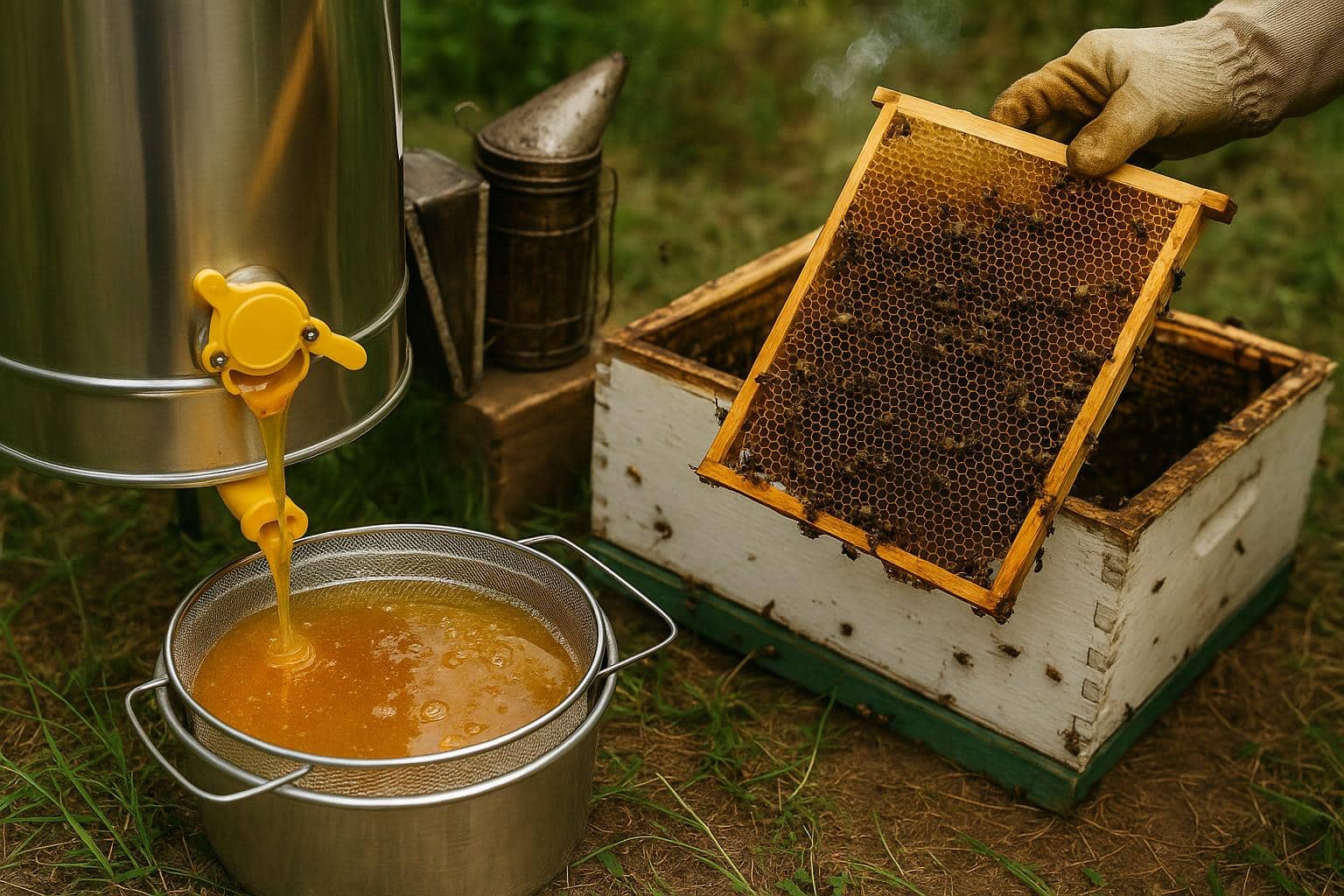
Honey is best extracted at about 21–27 degrees Celsius, at which point the wax cappings can be thinly sliced with a butter knife and placed in a colander. The uncapped frames can then be placed into a special machine called an extractor, where the honey is removed from the comb by cranking the handle for at least one minute. Honey then flows out of the extractor valve and into a jug or bucket.
The honey should then be strained through a filter and left to settle for about 24 hours, at which point it’s time to remove the bubbles, solids and wax that may rise to the top. The honey is then ready to be consumed or stored in a jar for future use.
About Gareth Booth
Mr. Booth is commercial director of Copius Group and has held senior leadership roles across operational management and finance, including finance and projects group director at The Bank of London and chief financial officer at MetaCompliance. He has also managed multi-site operations in the automotive sector with Inspired Business Investments. A Queen’s University Belfast accountancy graduate, he is a member of the Institute of Directors and an associate member of the Chartered Management Institute, and he maintains an active interest in beekeeping.
