


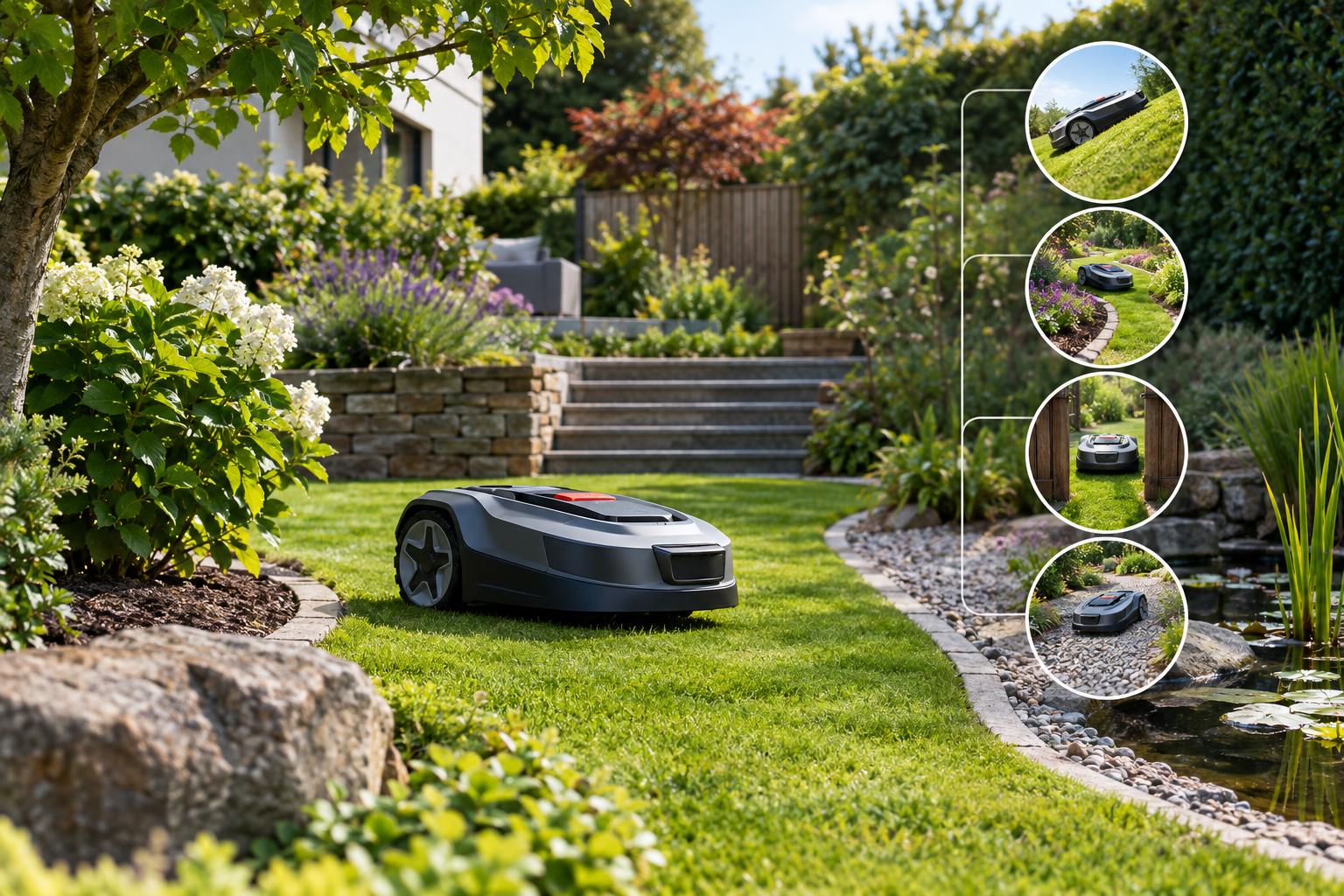
Not every garden is a perfectly rectangular stretch of grass with nothing standing in the way. In fact, most aren’t. There’s the apple tree that’s been growing in the same spot for thirty years, the flowerbed that curves around the patio, the narrow passage beside the shed and the awkward slope that makes conventional mowing particularly exhausting. Throw in a few garden chairs, wandering pets and a collection of children’s toys, and it’s easy to assume that a robotic lawnmower would struggle to cope. After all, how could a machine possibly navigate a garden that even its owner finds difficult to maintain?
The answer might be more encouraging than you expect. Robotic mowing technology has developed considerably, and modern machines can deal with garden features that would have presented serious difficulties to earlier models. Advanced navigation systems, intelligent mapping and improved obstacle detection have made robotic lawnmowers practical for a much wider range of properties. However, there’s a difference between a machine being advertised as suitable for complex gardens and genuinely being capable of managing your particular outdoor space. Understanding that distinction is essential before investing in equipment that promises to take the effort out of lawn maintenance.
Consider a typical established British garden. Unlike a newly landscaped lawn, it may have evolved over several decades, with features added whenever space and circumstances allowed. A tree was planted to provide shade, a greenhouse appeared near the vegetable patch, and a flowerbed gradually expanded into an area that was once entirely grass. The lawn itself might wrap around these features, creating corners, narrow sections and irregular boundaries. None of this necessarily makes robotic mowing impossible, but it does mean the machine must be capable of recognising where it should cut, navigating between different sections and avoiding objects that don’t belong on the lawn.
Older robotic lawnmowers generally relied on physical boundary wires to establish their working areas. These systems remain available and can be extremely effective, particularly when properly installed. However, navigating complicated boundaries requires careful planning, and altering the garden layout may involve repositioning sections of cable. More recent wire-free machines use technologies such as satellite positioning, cameras and LiDAR sensors to establish their location and understand their surroundings. Depending on the model, owners can create virtual boundaries, establish separate mowing zones and adjust certain settings through a smartphone application. The result is greater flexibility, although different navigation technologies have their own strengths and limitations.
Trees provide an excellent example of why choosing the correct technology matters. A mature tree standing in the middle of a lawn may be relatively easy for a suitable robotic mower to navigate around. The machine simply needs to recognise or avoid the trunk while continuing to cut the surrounding grass. Dense tree cover, however, introduces a different challenge. Robotic mowers that depend heavily on satellite signals can experience positioning difficulties beneath thick foliage, particularly when surrounding buildings further restrict reception. Models incorporating additional navigation systems may cope better in these circumstances, while boundary-wire machines avoid reliance on satellite positioning altogether. The important point is that a mower capable of avoiding a tree isn’t necessarily equally capable of navigating an entire garden beneath a dense canopy.
Flowerbeds and decorative borders present another common concern. Nobody wants a robotic mower wandering into carefully planted areas and flattening expensive perennials. Fortunately, compatible machines can be configured to respect designated exclusion zones, either through physical boundary arrangements or virtual mapping. This allows the mower to work around established planting without treating every part of the garden as grass. However, the accuracy of boundary management varies between machines, and there may still be narrow strips that require occasional trimming by hand. Owners should also consider whether plants overhang the lawn, particularly where flexible stems or spreading foliage might interfere with the mower’s progress.
Sloping gardens deserve even closer attention because advertised performance figures can be misleading when viewed without context. Manufacturers commonly specify the maximum gradient their machines can negotiate, but this doesn’t necessarily mean the mower can operate comfortably on every slope up to that figure. Ground conditions, surface moisture, wheel traction and the position of obstacles can all influence performance. A mower may be capable of climbing a steep grassy bank under suitable conditions but struggle when turning on wet ground or approaching an incline at an awkward angle. It’s also important to distinguish between maximum slope capability and the gradient permitted near boundaries, where some models have stricter limitations.
For homeowners with particularly challenging lawns, four-wheel-drive robotic mowers and models with enhanced traction may offer useful advantages. However, purchasing a machine with exceptional climbing ability isn’t necessary if the garden is mostly level. As with conventional garden equipment, paying for capabilities that won’t be used rarely represents good value. Retailers such as Garden Machinery Direct offer a selection of robotic lawnmowers with different navigation systems and operating capabilities, allowing buyers to consider equipment suited to their specific garden rather than assuming one type of machine will work everywhere.
Narrow passages are another feature that can separate a suitable robotic mower from an unsuitable one. Many gardens have strips of grass connecting larger lawn areas, perhaps running between a fence and a flowerbed or around the side of a property. Modern robotic mowers can navigate certain restricted routes, but minimum passage widths vary considerably between models. Some machines can follow carefully defined routes through narrow spaces, while others require more generous clearance to manoeuvre successfully. Sharp corners and uneven surfaces can make a passage more difficult even when it appears wide enough on paper. Measuring the narrowest points accurately before buying is therefore far more useful than relying on a general claim that a mower supports multiple zones.
Then there are the obstacles that refuse to stay in one place. Garden furniture gets moved around, toys appear unexpectedly, and watering equipment may be left on the grass after a busy afternoon. Some modern robotic mowers use cameras, ultrasonic sensors or other detection systems to identify obstacles and adjust their routes. These features can reduce collisions and unnecessary interruptions, but they shouldn’t be regarded as infallible. Detection performance depends on the technology, visibility, object size and operating conditions. Small objects, loose cables and low-lying items may still cause problems, so keeping the lawn reasonably clear remains a sensible part of robotic mower ownership.
Families with children and pets should pay particular attention to this distinction. Modern robotic lawnmowers incorporate safety features, often including lift and tilt sensors that stop the blades under certain conditions. Nevertheless, these systems don’t remove the need for supervision and sensible operating arrangements. It’s advisable to schedule mowing when children and animals aren’t using the lawn and to follow the manufacturer’s safety guidance. A robotic mower should be treated as powered cutting equipment rather than an autonomous garden accessory that can operate without consideration for its surroundings.
Uneven ground raises a different set of questions. A lawn with gentle undulations may present little difficulty, but deep ruts, exposed roots, raised paving edges and substantial holes can interrupt the mower’s progress. Depending on ground clearance and wheel design, a machine might become stuck or produce an inconsistent cut. This doesn’t mean the lawn must be perfectly flat before robotic mowing becomes possible. Minor levelling work, removing unnecessary obstacles and improving particularly troublesome areas may be enough to make the garden suitable. In some cases, these improvements will also benefit conventional mowing and make the lawn safer and more enjoyable for everyday use.
One feature that’s frequently overlooked is access to the charging station. A robotic mower needs somewhere suitable to recharge, and the positioning of that location can influence how effectively it manages the entire garden. Installing the charging station in a convenient corner may seem logical, but the machine also needs sufficient access to approach and leave it reliably. Requirements vary by model, particularly for systems that use satellite positioning or external navigation equipment. A sheltered location might appear ideal, yet excessive obstruction could interfere with certain wireless systems. Considering the charging arrangement before purchasing can prevent frustrating installation difficulties later.
Interestingly, the size of a garden isn’t always the best indication of how demanding it will be for a robotic mower. A large, relatively open lawn may be straightforward for a suitable machine, while a much smaller garden filled with separate sections, obstacles and awkward boundaries can require more sophisticated navigation. Manufacturers’ recommended mowing capacities provide a useful starting point, but they shouldn’t be interpreted as guarantees of performance in every layout. Complex gardens may require more travel, additional manoeuvring and longer operating schedules to achieve consistent coverage.
There’s also the question of whether every corner needs to be maintained automatically. Homeowners sometimes reject robotic mowing because a machine cannot reach a particularly narrow strip or negotiate a small stepped section. Yet this assumes that purchasing a robotic mower should eliminate absolutely every aspect of lawn maintenance. For many households, removing the need to mow the majority of the grass regularly would still represent an enormous saving in time. Occasional attention with a grass trimmer or conventional mower may be a reasonable compromise, particularly when the alternative is continuing to cut the entire garden manually.
Before making a purchase, it’s worth walking around the lawn and viewing it from the perspective of a machine that must operate independently. Look at the narrowest spaces, check the steepest gradients and identify areas where trees or buildings might interfere with navigation. Consider how frequently objects are left on the grass and whether the lawn contains separate areas that cannot be reached without crossing steps or other obstacles. These observations will be far more useful when comparing models than simply measuring the total lawn area.
The technology is impressive, but the smartest robotic mower purchase isn’t necessarily the one with the longest list of features. It’s the one that can manage the actual conditions of the garden reliably, safely and with an acceptable amount of owner involvement. Some properties will suit a relatively straightforward boundary-wire machine, while others may benefit from advanced mapping, improved traction or sophisticated obstacle detection. And there will still be gardens where conventional mowing remains the more practical solution.
What has changed is the range of possibilities. An irregular lawn, a few mature trees or an awkward slope no longer automatically rules out robotic mowing. With the right equipment and realistic expectations, many gardens that initially appear too complicated can be maintained with surprisingly little routine effort. The garden doesn’t need to be redesigned around the mower; the challenge is finding a mower designed to work with the garden you’ve already got.
