


You’ve heard the word a thousand times. Blockchain. It gets thrown around in news headlines, crypto conversations, and tech pitches. But nobody seems to explain it like you’re a normal person with a full schedule and zero patience for jargon. So here it is, straight and simple.
What Blockchain Actually Is
Think of a blockchain as a shared notebook. Not one notebook sitting on one person’s desk, but thousands of identical notebooks spread across thousands of computers around the world. Every time someone writes something in one notebook, the same entry appears in all the others at the exact same moment.
That’s it. That’s the core idea.
Now here’s what makes it powerful. Once something is written in that notebook, it can’t be erased or changed. Not by one person. Not by a company. Not even by a government. The only way to alter a record would be to rewrite it in every single notebook simultaneously, which is practically impossible.
This is why people trust it.
The “Block” and the “Chain”
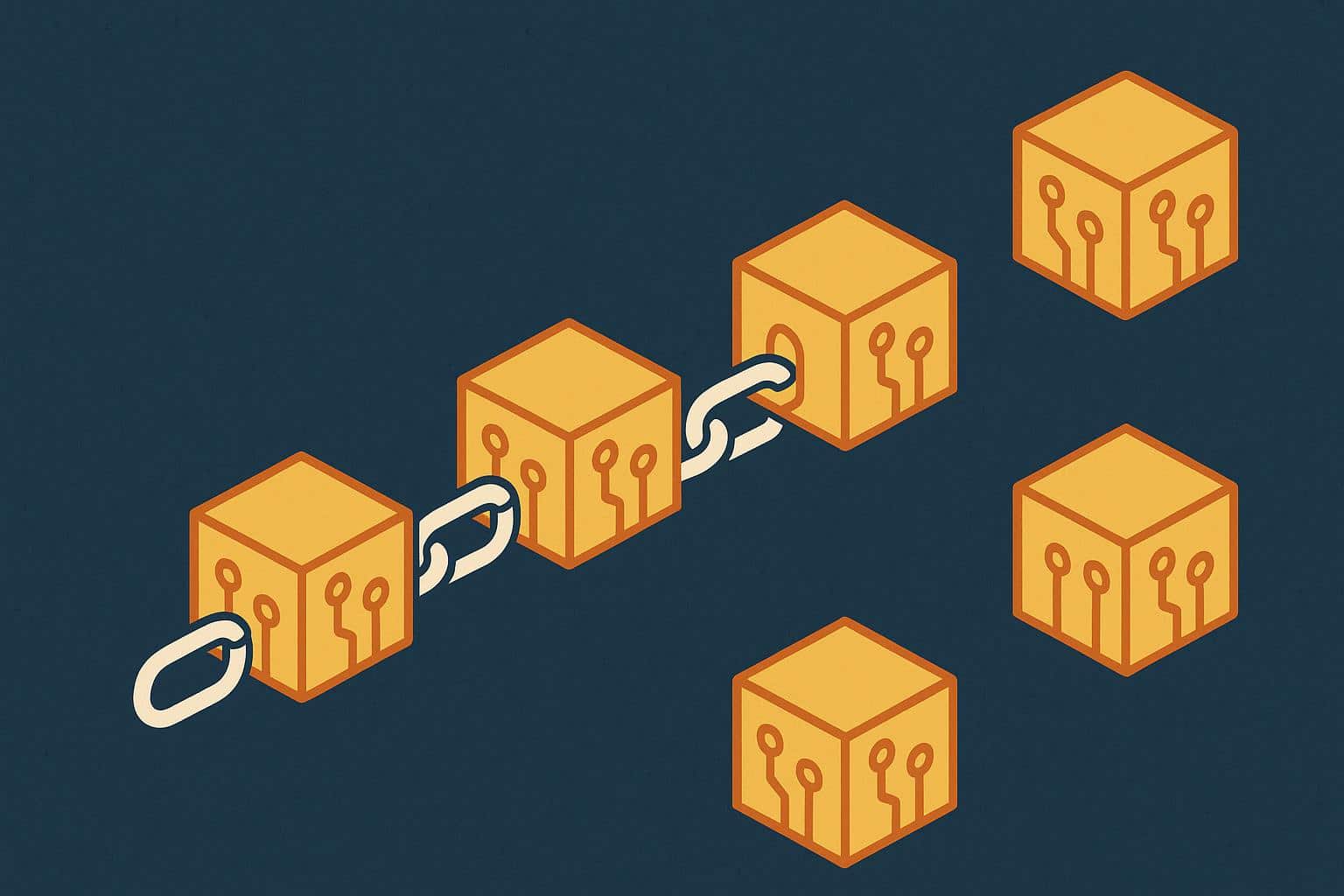
The name itself tells the story. Data gets grouped into blocks. Each block holds a set of transactions or records. Once a block is full, it gets locked and attached to the block before it. That creates a chain. Hence, blockchain.
Every block contains a unique code called a hash. It also contains the hash of the block before it. So if someone tried to tamper with an old block, its hash would change, which would break the chain, which would immediately signal to the entire network that something was wrong. The system catches fraud on its own.
Why It Matters Beyond Crypto
Most people connect blockchain to Bitcoin, and that connection makes sense. Bitcoin was the first major use case. But the technology has grown far past digital currency.
Hospitals use blockchain to store patient records securely. Supply chains use it to track products from factory to shelf. Voting systems are being tested on it to prevent fraud. Real estate companies are using it to record property transfers without mountains of paperwork.
Anywhere trust between strangers is required, blockchain can step in as a neutral referee.
Bitcoin and the Real World
Speaking of Bitcoin, the way people actually interact with it has become remarkably simple. You don’t need a finance degree or a tech background anymore. Services have made crypto as accessible as an ATM on the corner.
Take Miami, for example. The city has leaned into the crypto world harder than almost anywhere else in the country. If you’re in the area and want to buy or sell Bitcoin with cash, a Miami Bitcoin ATM lets you do exactly that in minutes. You walk up, insert cash, and Bitcoin lands in your digital wallet. No bank. No broker. No waiting three business days. The blockchain handles the transaction, verifies it across the network, and it’s done.
That’s blockchain working in the real world, not in a whitepaper.
Decentralization Is the Point
The reason blockchain gets so much attention isn’t just the technology. It’s the philosophy behind it.
Traditional systems rely on a central authority. A bank approves your transfer. A company stores your data. A platform controls your account. Blockchain removes that middleman. It distributes control across the entire network, so no single point of failure exists and no single entity holds all the power.
This is called decentralization, and it’s the idea that keeps developers, investors, and governments both excited and nervous about where all of this is headed.
Is It Perfect?
No. Nothing is.
Blockchain networks can be slow compared to traditional payment systems. They consume significant energy, especially proof-of-work systems like Bitcoin. Regulations are still catching up globally. And because it’s decentralized, if you lose access to your crypto wallet, there’s no customer service line to call.
The technology is powerful, but it’s not a cure-all. Like any tool, it works brilliantly in the right hands for the right job and falls flat when it’s forced where it doesn’t belong.
The Short Version
Blockchain is a shared, unchangeable record book maintained by thousands of computers worldwide. It makes trust possible between strangers without needing a bank, a lawyer, or a government to stand in the middle. Bitcoin was the first major product built on it, but the applications stretch across almost every industry.
If you’ve been waiting to understand what all the noise is about, now you know. And if you’re in South Florida and want to turn that understanding into actual Bitcoin, a Miami Bitcoin ATM is one of the easiest on-ramps you’ll find anywhere.
The technology is real. The future it’s building is already here. You don’t have to be a tech expert to be part of it. You just have to understand enough to take the first step.
