





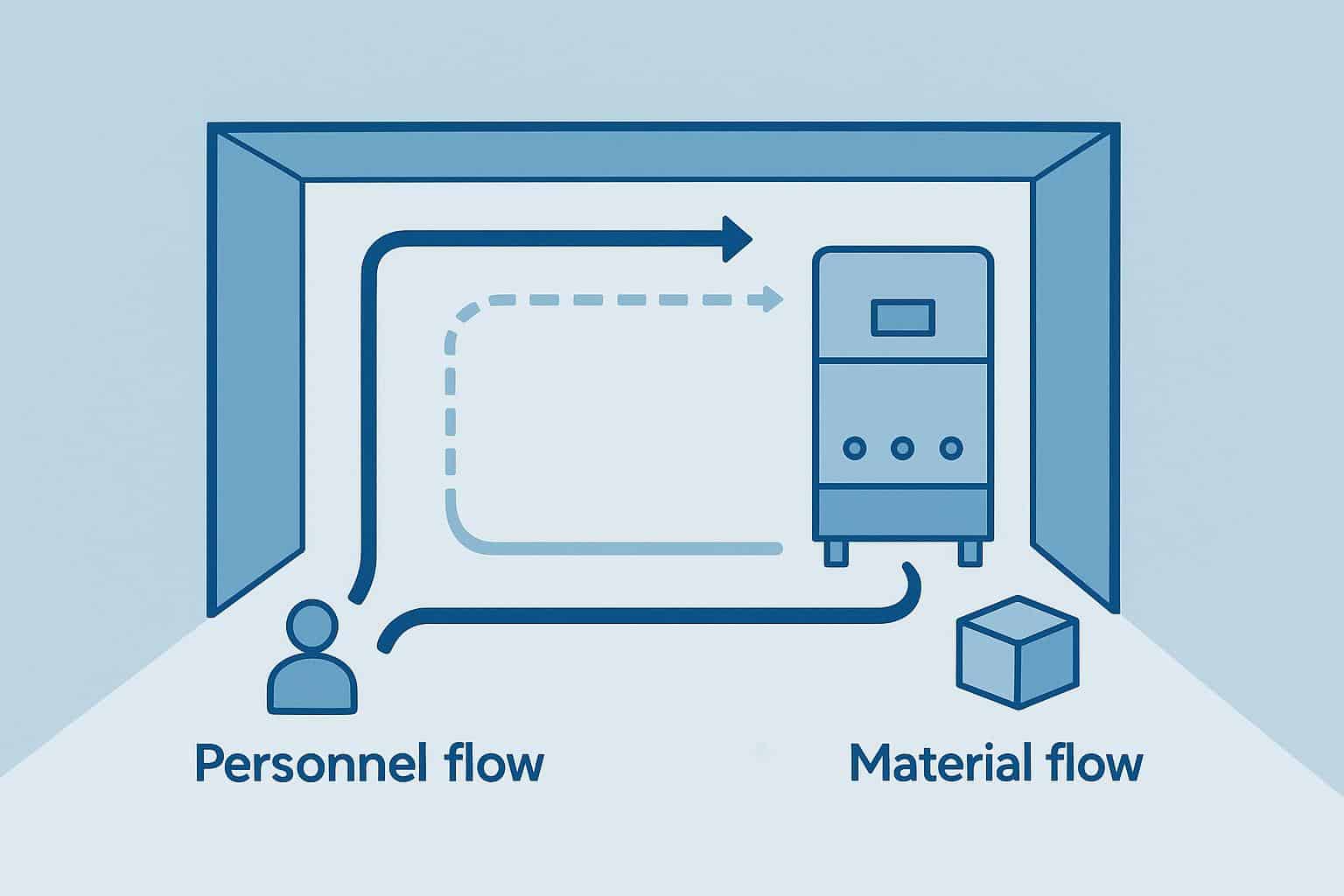
When manufacturers discuss cleanroom performance, they usually focus on filters, ISO class, and HVAC capacity. These are important, but they are not the only factors that determine whether a cleanroom works well. In many GMP-related projects, the biggest risks come from daily movement: people entering the room, materials being transferred, tools being carried inside, and doors opening throughout the shift.
This is why a gmp cleanroom should be planned around behavior as much as equipment. A well-designed system should guide operators to move correctly, reduce unnecessary door opening, and separate clean and less-clean activities in a practical way. If the cleanroom relies only on written procedures but the layout makes those procedures difficult to follow, contamination risk increases.
People are one of the most active particle sources in any controlled environment. Clothing, shoes, exposed skin, movement, carts, and handling habits can all introduce particles into cleaner areas. For pharmaceutical, medical device, laboratory, food, and electronics facilities, controlling how people enter the cleanroom is a basic part of contamination management.
This is where air shower can support the entry process. Their role is not only to remove loose particles from garments with filtered high-velocity air. They also create a controlled transition point before personnel enter the clean zone. Interlocked doors, timed cycles, and defined access routes help prevent uncontrolled movement from ordinary factory areas into more sensitive spaces.
However, air showers should not be treated as a standalone solution. They work best when combined with proper gowning areas, cleanroom clothing, operator training, and a logical room sequence. If the air shower is located in the wrong place or operators can bypass it easily, its value is reduced. The equipment must support the workflow, not interrupt it.
Material flow is just as important. In a pharmaceutical cleanroom, packaging components, samples, production tools, spare parts, documents, and small equipment often need to move between rooms. If workers open the main cleanroom door every time materials are transferred, pressure stability and cleanliness can be affected. Over time, these small disruptions can become a regular source of contamination risk.
Pass boxes help solve this problem by creating a controlled transfer point between different areas. Instead of moving people and materials through the same door, a pass box allows materials to pass through while maintaining separation between clean and less-clean spaces. Interlocked doors help prevent both sides from opening at the same time, which supports pressure control and cleaner operation.
This is also where cleanroom gmp becomes more than a search term or a general compliance phrase. In real projects, GMP expectations are reflected in the way a cleanroom controls people, materials, pressure, airflow, cleaning, and documentation. A facility may have good filters and professional-looking panels, but if the daily movement of operators and materials is poorly controlled, the cleanroom may still create quality risks during routine production.
Door planning is another detail that deserves attention. Every door opening can disturb pressure and airflow. A cleanroom with too many poorly located doors may be harder to control than a smaller but better-designed space. Airlocks, pass boxes, and controlled entry points help reduce unnecessary traffic and protect the cleanroom environment.
For GMP cleanrooms, documentation is part of the system. Entry procedures, gowning steps, material transfer rules, cleaning schedules, and equipment maintenance records should all support the contamination-control strategy. Air showers and pass boxes are physical tools, but their effectiveness depends on how they are used and maintained.
Maintenance should not be ignored either. Air showers and pass boxes include components such as filters, nozzles, seals, interlocks, lamps, sensors, and control panels. If these are not inspected and maintained, the equipment can become a weak point instead of a protective barrier. Good cleanroom operation includes both daily procedures and routine equipment checks.
In the end, cleanroom performance is not only about how clean the air is when the room is empty. It is about how well the room handles real production movement. By controlling personnel entry and material transfer with the right systems and layout, manufacturers can make GMP cleanroom operation more stable, practical, and reliable.

